Unfortunately, the risk of fire in a tunnel system can never be completely ruled out. However, to keep the risk to people and property damage as low as possible, preventive structural fire protection measures are absolutely necessary. These are based on extensive calculations and tests regarding fire progression and fire temperature. The fischer range consists of a variety of dowels and anchors that have been subjected to fire testing according to special fire curves (DIN 4102, RABT/ZTV, Rijkswaterstaat curve).
Of course, fischer also offers various systems for increased anchoring depths. In fact, there are different tunnel fire curves, and it depends on the country and the standard which one is used for the tunnel project. The RAB/ZTV tunnel curve (Germany) rises to 1,200 °C within 5 minutes. Anchors approved for the RAB/ZTV curve include the FAZ II, FHB II, and FHB dyn, M16 in material 1.4529.
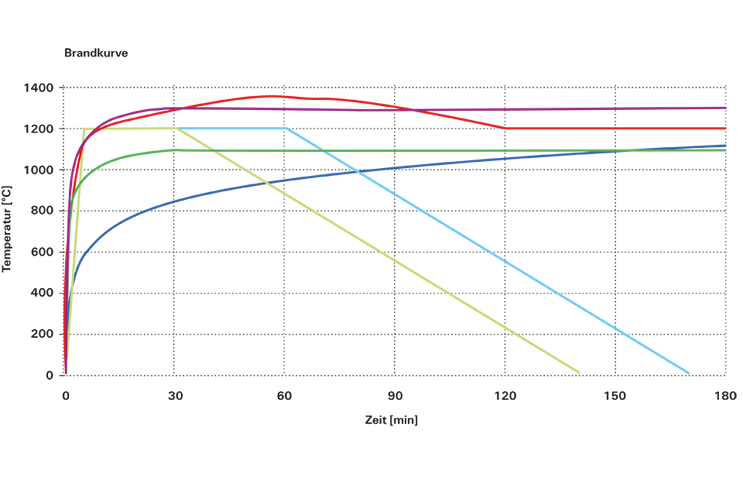
With an even higher temperature load, the Rijkswaterstaat tunnel fire curve (Netherlands) tests the systems with their fasteners. For this fire curve with a maximum temperature of 1,350 °C, fire protection boards and spray systems with FNAII are tested in a realistic test. The last known tunnel fire curve is the Hydrocarbon curve.
This curve is based on the assumption of a fire involving flammable liquids, e.g. petrol, chemicals, etc., with 1,100 °C over a very long period. In some areas of a tunnel project that are not affected by traffic itself, other fire curves may be decisive. In Germany, for example, the standard temperature-time curve (ETK), which is based on the German standard DIN 4102 and ISO 834. For applications corresponding to this type of fire curve, the fischer range offers a wide selection of products.